
Fuel Consumption of the 50 Most Used Passenger Aircraft as Function of Flight Distance
Bachelor Thesis
Autor: Nisa López, Joel
Date: 2025-07-11
Supervisor: Dieter Scholz
Abstract
Purpose – The estimation of aircraft fuel consumption of passenger aircraft over varying flight distances is essential in flight planning and environmental assessment. The so-called Bathtub Curve represents fuel consumption per passenger per 100 km versus flight distance but is not discussed much. This could be changed by representing the function with a simplified analytical equation. As an example, the new function is applied for Intermediate Stop Operations (ISO). --- Methodology – Necessary for the calculation are only Maximum Take-Off Mass (MTOM), Maximum Zero-Fuel Mass (MZFM), number of seats, average mass of one passenger (including baggage) and the Payload-Range Diagram of the aircraft. Using these numbers and the Excel table developed by Burzlaff (2017), the fuel consumption was represented as a function of flight distance and five fitted constants (a, b, c, d, e) for each of 50 of the most used passenger aircraft. The constants were fitted using Excel's Solver. With an Excel table, the aircraft with the lowest fuel consumption for a given flight distance was determined for normal operation as well as for different ISO strategies. --- Findings – Fuel consumption represented with the Bathtub Curve was determined and successfully approximated for 50 aircraft, revealing minimum fuel consumption and its flight distance for each aircraft type. The analytical equation showed minimal deviation from the full model. The ISO analysis, applied to the Perth–London route, showed that using a rangeoptimized aircraft for two legs can reduce fuel per passenger compared to a single-leg flight by 7.4%. --- Research Limitations – The calculation of aircraft fuel consumption is limited only by available data. Mostly, sufficient input data is available or can be estimated. --- Practical Implications – Now, absolute fuel consumption and fuel consumption per passenger and 100 km as a function of flight distance can easily be calculated. Respective solutions are given for 50 passenger aircraft. For a given flight distance, the aircraft with the lowest fuel consumption can be found. This also allows a quick answer for possible savings from ISO. --- Social Implications – Passenger aircraft fuel consumption as a function of flight distance can be discussed openly independent of otherwise missing manufacturer's data based on a simple equation. --- Originality – While the Bathtub Curve itself is not new, this work expands its use by proposing an analytical approximate equation for fast calculations and provides results for 50 passenger aircraft.
Download full text
 TextNisaLopez.pdf
Size: 5.1M
Download presentation
VortragNisaLopez.pdf
Size: 3.9M
Download DGLR-paper
PaperNisaLopez.pdf
Size: 890K
URN, the Persistent Identifier (from the German National Library) to quote this Landing Page:
https://nbn-resolving.org/urn:nbn:de:gbv:18302-aero2025-07-11 
Entries into
- the German National Library (https://www.dnb.de),
- the Repository of Leibniz University Hannover (https://www.repo.uni-hannover.de) for the DOI,
- and the Internet Archive
will come later.
Associated research data: https://doi.org/10.7910/DVN/6FWVDM
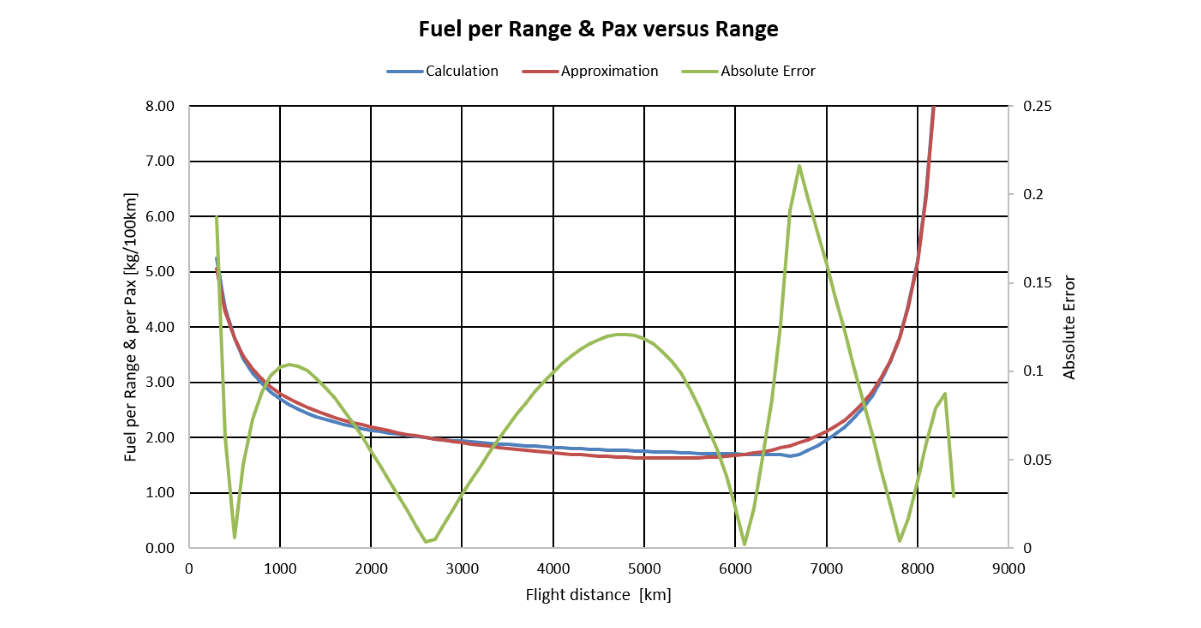
Bathtub curve of the Airbus A321neo.
LAST UPDATE: 13 October 2026
AUTHOR: Prof. Dr. Scholz
IMPRESSUM (PDF)

 Prof. Dr. Scholz
Aircraft Design and Systems Group (AERO)
Aeronautical Engineering
Faculty of Aviation and Automotive Systems
Hamburg University of Applied Sciences