

|
|
| Download full text: |
 TextRoesing.pdf
Size:
72M TextRoesing.pdf
Size:
72M |
| Date: | 2022-07-30 |
| Type of work: | Project |
| Advisor / Examiner: | Dieter Scholz |
| Published by: | Aircraft Design and Systems Group (AERO), Department of Automotive and Aeronautical Engineering, Hamburg University of Applied Sciences |
This work is part of: |
Digital Library - Projects & Theses - Prof. Dr. Scholz ---
http://library.ProfScholz.de
 |
| PERSISTENT IDENTIFIER: | |
| URN: | https://nbn-resolving.org/urn:nbn:de:gbv:18302-aero2022-07-30.018 (to reach this page) |
| DOI: | https://doi.org/10.15488/20754 |
| ARK: | https://n2t.net/ark:/13960/s2p86z86ckg |
| Associated research data: | https://doi.org/10.7910/DVN/UEJFOS (Program and data) |
| URLs registered with URN: | Show all links associated with this text! |
| CATALOG ENTRY: | |
| DNB: | Check inclusion of this title in German National Library! |
| WorldCat: | Check inclusion of this title in WorldCat! |
| DataCite: | Check inclusion of this title in DataCite! |
| Google Scholar: | Check inclusion of this title in Google Scholar! |
| OpenAIRE: | Check inclusion of this title in OpenAIRE! |
| Semantic Scholar: | Check inclusion of this title in Semantic Scholar! |
| BASE: | Check inclusion of this title in BASE! |
| CORE: | Check inclusion of this title in CORE! |
| Google: | Check inclusion of this title in Google! |
| Keywords, German (GND): | Luftfahrt, Luftfahrzeug, Luftverschmutzung, Klimaänderung |
| Keywords, English (LCSH): | Aeronautics, Airplanes, Air--Pollution, Climate Changes |
| Keywords, free: | Treibhauseffekt, Umwelt, Reise, Luftverkehrsgesellschaft, Passagier, Abgasemission, global warming, greenhouse effect, passenger, aviation, aircraft, ecolabel, fuel performance, route, flight, distance, dispatch, hub, spoke, greenwashing, ICAO, EASA, IATA |
| DDC: | 629.13, 629.133340423, 304.28, 363.7392 |
| RVK: | ZO 7610 |
© This work is protected by copyright
The work is licensed under a Creative Commons Attribution-NonCommercial-ShareAlike 4.0 International License
CC BY-NC-SA
https://creativecommons.org/licenses/by-nc-sa/4.0

Any further request may be directed to:
Prof. Dr.-Ing. Dieter Scholz, MSME
E-Mail see: http://www.ProfScholz.de
VISIBILITY: (more)
Share this text:



Quote this text:
| ISO 690: RÖSING, Christian, 2022. Analysis of Flight Routes and Hints for Passengers - The Trip Emission Ecolabel. Project. Hamburg University of Applied Sciences, Aircraft Design and Systems Group (AERO). Available from: https://nbn-resolving.org/urn:nbn:de:gbv:18302-aero2022-07-30.018 [viewed YYYY-MM-DD]. |
Major results / graphical abstract:
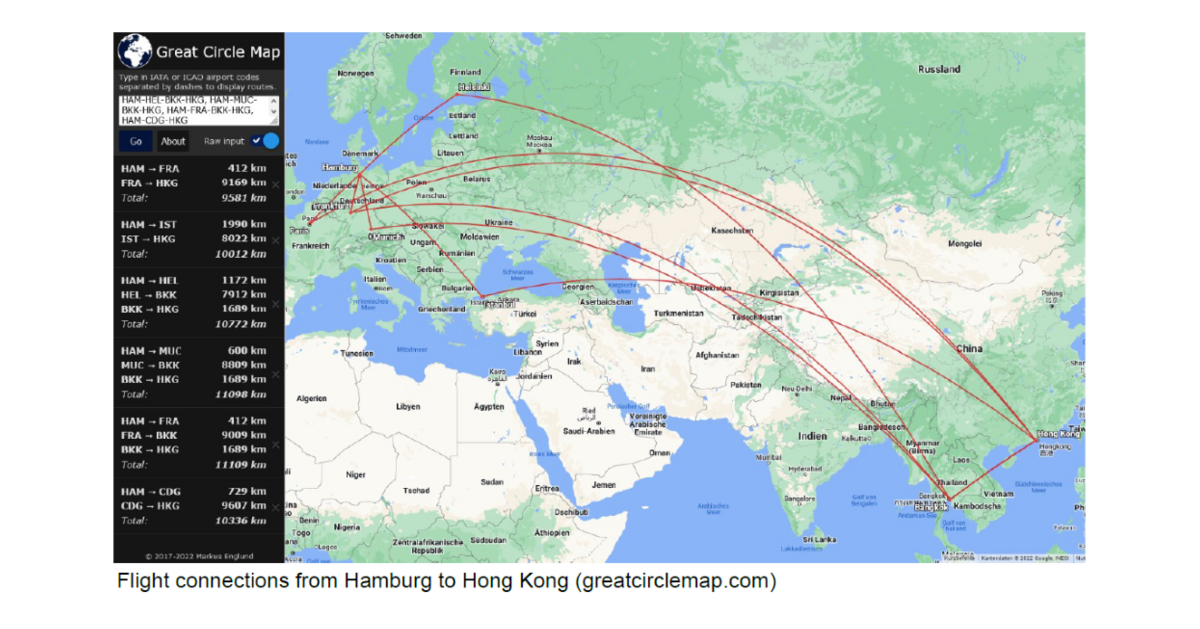
Flight connnections from Hamburg to Hong Kong show a wide variation of flight distances.
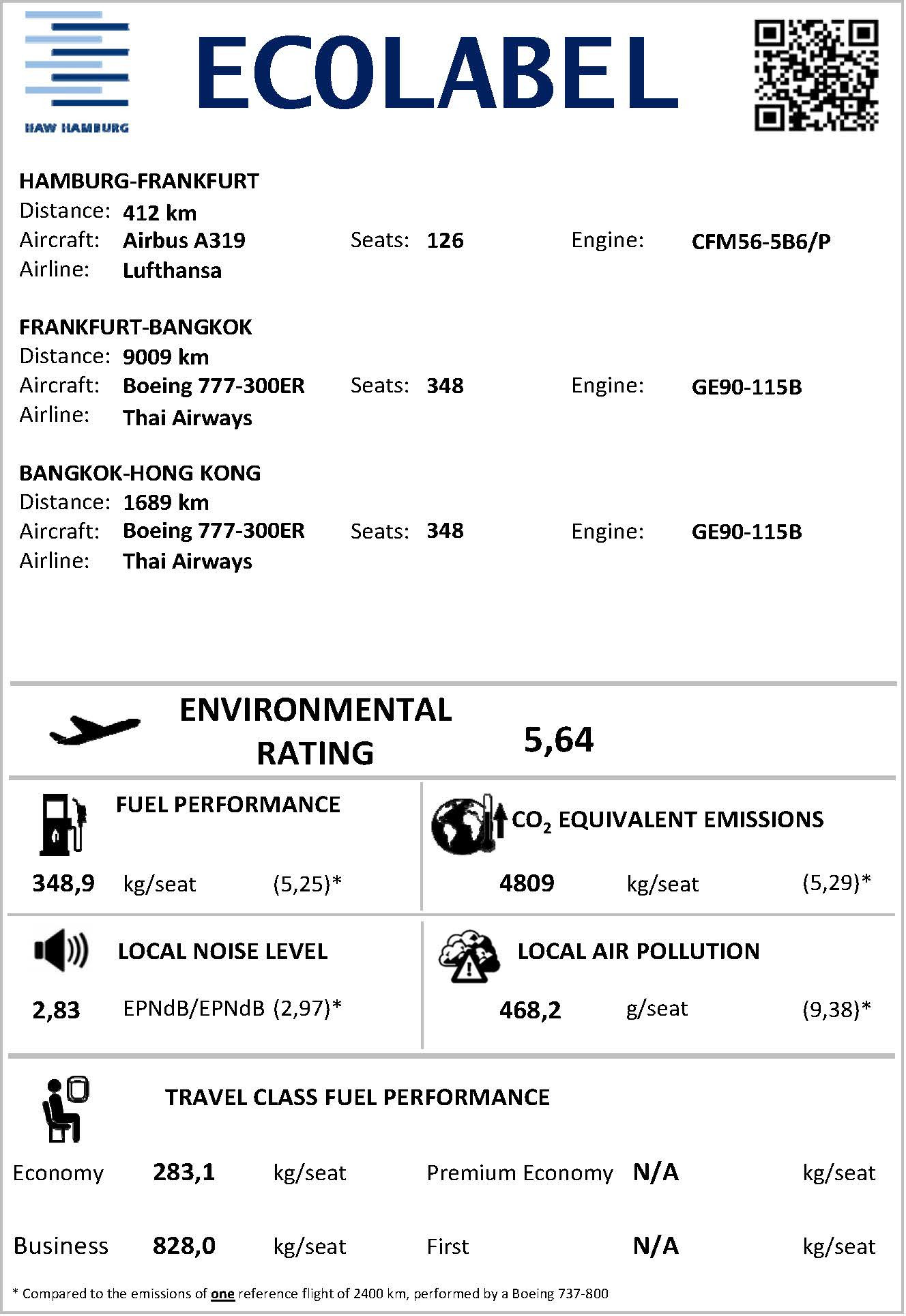
The Trip Emission Ecolabel (TEE) shows absolute values of e.g. fuel consumption and equivalent CO2 emissions. The factors (5,25) or (5,29) show, how much more this is relative to a standard flight (with a standard aircraft, Boeing 737-800, on a typical flight distance, 2400 km). The (overall) ENVIRONMANTAL RATING – 5,64 – shows the overall burden of this flight as a factor comparing this long distance flight with the values of the defined standard flight (2400 km).
Front page:

 Prof. Dr. Scholz
Aircraft Design and Systems Group (AERO)
Aeronautical Engineering
Faculty of Aviation and Automotive Systems
Hamburg University of Applied Sciences